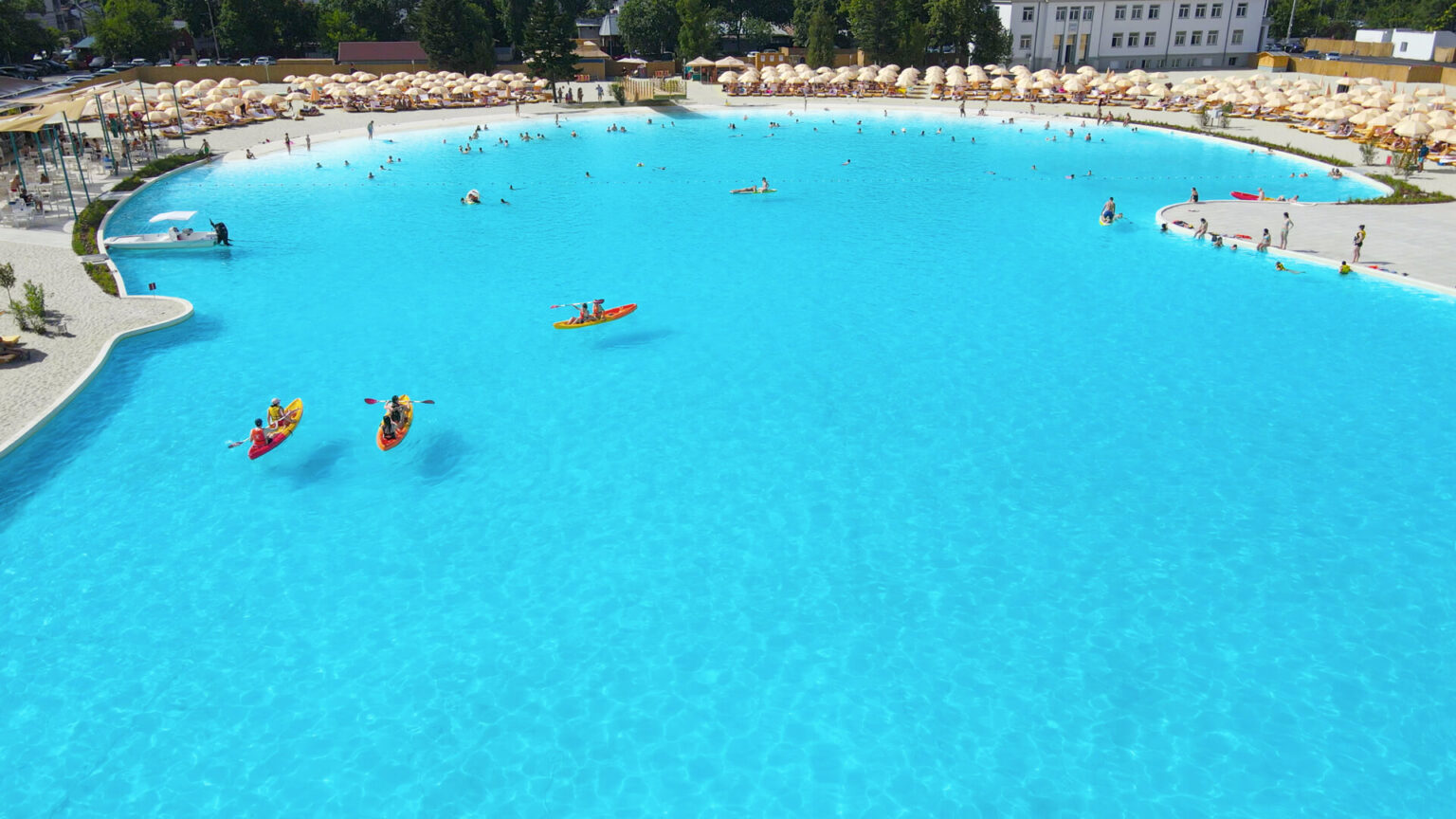
Crystal Lagoons U.S. Corp.® Sees Strong Sales Performance and Potential

With a number of successes in master-planned community amenity developments under its belt, Miami-based technology company Crystal Lagoons® is pursuing a new business model for amenity development, which consists of master licensing agreements for Public Access Lagoons™. The following is a publication released by Builder Online, a U.S. magazine that recently covered the firm’s success in the U.S. market.

The company’s exclusive partners are set to use Crystal Lagoons technology package to create public amenities across the U.S. anchored by beaches, retail, and other attractions. Between December 2019 and May 2020, the company had signed master licensing agreements for 16 new lagoons in the U.S., as well as many more overseas.

While the COVID-19 pandemic has placed restrictions on the company’s activity and prompted the closure of some amenities at the beginning of the pandemic—including the one at the Epperson community in Wesley Chapel, Fla.—Crystal Lagoons anticipates that its amenities will play important roles in a future economic recovery, particularly as sites for “mini-vacations” in a time when air travel is limited.

“Given that these are long-term projects that will not be completed in less than one-and-a-half years, the business’ dynamism hasn’t been affected by the pandemic,” says Iván Manzur, who is expected to assume the position of vice president of sales at Crystal Lagoons U.S. Corp. “On the contrary, we’ve seen investors moving forward, and these projects have been perceived as having a potential of reactivating the economy.”

BUILDER magazine spoke with Manzur about the company’s future plans and sales performance, as well as its management of the COVID-19 pandemic, opportunities as travel and recreation habits shift, and expectations for business under the “new normal.”

BUILDER: How has your public access lagoon business expanded in the U.S. over the past year? Can you tell me about the status of some of your projects?

Manzur: The United States is one of the main markets for Public Access Lagoons™, also known as PAL™. Although these projects started as real estate, they quickly converted to the PAL business model, as in the case of Epperson, which opened up a section of the lagoon allowing public access. People started going to the beach, and the outcome has been so remarkable that the development has often had to close the doors to control the flow of visitors.

Later, PAL projects emerged, with public access only, which were in association with amusement parks, for example. Since, the growth has spiked producing the first master licenses with renowned multinational companies, such as the signing with Epic to develop 16 projects across the U.S. Our business plan shows a potential projection of 1,000 developments of this type in the U.S. alone.

BUILDER: How do you believe economic reactivation measures will affect Crystal Lagoons?

Manzur: Every reactivation measure promoted by the U.S. is important. In the case of Crystal Lagoons, we can divide ours into two aspects. Regarding real estate projects that are currently in development, the measures will allow, in the short term, to increase the purchase of properties while also allowing people to partially restore the normality they are accustomed to.

In the case of PAL projects to be developed in the medium or long term, these reactivation measures will likely not have a major impact.

BUILDER: According to Crystal Lagoons, the company expects that families will look to have “mini holidays” in lieu of air travel this summer. Can you elaborate on this idea?

Manzur: The pandemic, even if it’s controlled in the future (vaccines, etc.), may change certain social habits, such as avoiding plane trips to distant locations due to risks associated with large groups of people boarding planes, at airports, confinement in planes, coming into contact with people from other countries where infection rates are possibly unpredictable, etc.

Being able to have beach life and recreational activities close to home reduces considerably many of these risks and could become a future trend.

Touristic destinations and public beaches are difficult to control on a sanitary level. On the other hand, on a private beach, such as is the case of PAL, access can be controlled by using tests, regulating its capacity, ensuring distances are respected, etc.

In fact, investors have identified that people will prefer to unwind in areas close to home, which will require infrastructure to be developed. These types of areas within cities will be especially necessary after confinement.

This concept of beach life just steps away from home positively impacts people’s carbon footprint and reduces the impact on biodiversity in natural places.

BUILDER: How have Crystal Lagoons amenities in residential communities fared? How are communities implementing safety measures?

Manzur: Epperson reopened its doors once COVID restrictions were lifted and has received a large number of people. What’s surprising is that, despite the current economic situation, commercial activity has been maintained, confirming the good results that Crystal Lagoons projects have always experienced in the U.S. An example of this are three new projects soon to open in Florida (Southshore Bay, Mirada, and Avenir) and Sierra Vista in Houston.

As for preventive measures, although the amenities and lagoons in the real estate projects were closed for a month, they are reopening and starting to operate normally.

BUILDER: What do you believe the future will hold for Crystal Lagoons?

Manzur: As previously mentioned, Crystal Lagoons is undergoing a structural change, registering the highest sales in its history, and is dynamically closing contracts.

Along with the master licenses previously signed around the world and the above mentioned negotiations, we’ve seen that there is a large market in the main U.S. mall chains, as several need to reinvent themselves and we’re in advanced conversations with them. The fall in their sales caused by e-commerce and an increase in unoccupied spaces has forced them to introduce new functional alternatives and new experiences, such as these lagoons.

Malls see in PAL a new hook or “anchor” to attract public. There is an important market here, and we foresee a great future reconverting these shopping centers.

Crystal Lagoons is an international innovation company, founded by scientist Fernando Fischmann, which has developed a patent-protected technology that allows the construction and maintenance of unlimited-size clear water lagoons at very low costs.

Outstanding news

  • Innovative technology transforms waste heat into a competitive advantage, allowing people to enjoy crystalline lagoons with pleasant water temperatures year-round, while offering greater energy efficiency and a sustainable approach for real estate developers.

At the intersection of the digital revolution and urban sustainability, a critical question emerges for developers: How can industrial waste be transformed into a luxury asset? The answer comes from Crystal Lagoons and its innovative Eco-Heated Lagoons by Crystal Lagoons™ technology.

This solution not only makes it possible to maintain idyllic water temperatures year-round, but does so by redefining the concept of the circular economy. By capturing the waste heat generated by industrial processes—specifically from data centers and crypto mining Crystal Lagoons creates a perfect symbiosis between technological infrastructure and human well-being.

What Are Eco-Heated Lagoons by Crystal Lagoons™?

Eco-Heated Lagoons by Crystal Lagoons™ technology harnesses waste heat from data centers and crypto mining and redirects it to a lagoon that acts as a highly efficient heat sink. In this way, a resource that would normally be lost to the atmosphere becomes a competitive advantage for the development that integrates it. This system makes it possible to create a tropical beach area with water temperatures between 80°– 86°F, and even a thermal area at 98.6°F, all powered by waste heat and without using energy to heat the lagoon.

This proposal not only addresses an operational need. It also redefines the value of a lagoon: it is no longer just a visual or recreational amenity, but rather an infrastructure capable of extending water use year-round and enhancing a project’s appeal in markets where seasonality often limits profitability.

Why This Innovation Matters More Than Ever Today

The rapid growth of digital infrastructure is intensifying the energy pressure on data centers. Projections vary depending on the methodology, but they all point in the same direction: in the United States, data centers currently account for around 3% of electricity generation and could reach 8% by 2030. At the same time, the International Energy Agency highlights that reusing waste heat from data centers can help heat nearby buildings, provided there is sufficient proximity and proper technical integration.

That context makes solutions that reduce cooling loads and give discarded heat a new purpose especially valuable. Crystal Lagoons proposes precisely that paradigm shift: transforming an energy challenge into infrastructure that is useful, visible, and profitable for its surroundings.

Synergy with Data Centers: The Future of Sustainable Cooling

Data centers are the engines of the modern economy, but they face a monumental challenge: cooling. Traditional systems (chillers and cooling towers) consume massive amounts of electricity and potable water. This is where Eco-Heated Lagoons by Crystal Lagoons™ transforms the equation:

  • Reduction in Operating Costs (OPEX): By using the lagoon as a natural cooling system, data centers can drastically reduce their reliance on mechanical chillers, lowering energy consumption.
  • Significant Water Savings: Unlike cooling towers that constantly evaporate water, the lagoon recirculates heat in a closed and efficient way.
  • Improved PUE (Power Usage Effectiveness): This integration allows data center operators to achieve higher energy efficiency metrics, which are essential for meeting global ESG standards.

Strategic Advantages for Real Estate and Hospitality

For a real estate developer, the ability to offer a sustainably heated lagoon is the ultimate differentiating factor.

  1. Uninterrupted Use (365 days a year): Eco-Heated Lagoons by Crystal Lagoons™ ensures that the project’s main amenity is not seasonal. The “beach lifestyle” remains active even in the middle of winter, maximizing user satisfaction and return on investment.
  2. Certified Sustainability: By not using fossil fuels to heat the water, the project positions itself at the forefront of sustainable urbanism, facilitating green certifications and attracting climate-conscious institutional investors.
  3. Asset Appreciation: A project that integrates cutting-edge technology and a circular economy model has a much more powerful commercial narrative, increasing the value of the surrounding properties.

A Unique Circular Economy Model in the World

The concept behind Eco-Heated Lagoons by Crystal Lagoons™ is simple yet revolutionary: nothing is wasted, everything is transformed.

  • Input: Waste heat from industrial processes or data centers.
  • Process: Patented heat exchange technology by Crystal Lagoons.
  • Output: A world-class amenity with crystalline water at the perfect temperature, with no additional CO2 emissions.

From Waste Heat to a High-Impact Amenity

What is most compelling about this technology is that it connects two needs that have historically been separate. On one hand, data centers must dissipate heat efficiently. On the other, developers are looking for memorable amenities that enhance a project’s positioning. Eco-Heated Lagoons by Crystal Lagoons™ technology solves both challenges through a single infrastructure solution.

The technology can even be integrated into compact formats such as Small Lagoons by Crystal Lagoons™ models, with standardized models ranging from 5,400 sq ft to 1 acre, making it possible to offer a thermal beach experience year-round with support from data centers or crypto mining. This opens up a concrete opportunity for urban projects, hospitality developments, and projects that previously could not aspire to an amenity of this level.

A Solution Aligned with the New Energy Economy

The conversation around data centers is no longer limited to power, latency, or availability. Today, it also includes efficiency, social license, urban impact, and the smart use of resources. In this context, the Eco-Heated Lagoons by Crystal Lagoons™ technology offers a forward-looking solution: reusing waste heat to create tropical and thermal beach destinations that can operate year-round, with a more sustainable logic and a far more powerful commercial proposition.

For developers, it means incorporating an extraordinary amenity that enhances both the experience and the value of the project. For data centers, it means transforming a thermal load into an opportunity for efficiency and reputation. And for both, it represents a new way of understanding infrastructure: not as an isolated cost, but as a platform for creating value.

Innovation Can Turn an Energy Challenge into an Advantage

Eco-Heated Lagoons by Crystal Lagoons™ technology demonstrates how innovation can turn an energy challenge into a tangible competitive advantage. By harnessing waste heat from data centers to maintain crystalline lagoons at pleasant temperatures year-round, this technology creates a new category of sustainable amenities with a real impact on differentiation, monetization, and operational efficiency.

In a market where infrastructure must become increasingly smarter, cost-effective, and more responsible, Crystal Lagoons proposes a simple yet powerful idea: turning heat that was once wasted into an experience people want to enjoy all year long.

Original content

  • Turquoise waters, sandy shores, and activities: this new technology transforms multifamily developments into a place where people want to live and stay.

In 2026, the multifamily market is competing on a very specific battleground: the resident’s everyday experience. It’s no longer enough to simply “have a pool.” Today, the winning project is the one that becomes a place people want to live, stay, and recommend.

In that context, the patented Small Lagoons by Crystal Lagoons™ concept emerges as a true game-changing solution: a new amenity category for multifamily communities, capable of delivering resort-style beach living (turquoise waters + white sand) in compact spaces and at costs significantly lower than those of a traditional pool.

What is Small Lagoons by Crystal Lagoons™ and why is it different?

The Small Lagoons by Crystal Lagoons™ concept was designed to bring an idyllic beach experience to multifamily communities, in areas starting at 5,400 sq ft, with standardized models that make implementation easier.

Unlike a swimming pool (which is often seen as “an add-on”), a small lagoon can become the social heart of the project: a true gathering point, highly visible and photogenic, that boosts the development’s appeal from day one.

The problem with “more of the same”: when the pool stops being a differentiator

In many cities, a pool is already a commodity. If every building offers the same thing, the amenity stops influencing the decision.

Small Lagoons by Crystal Lagoons™ models offers something different: They don’t compete only on size; they compete on experience. And that experience translates into the metrics that matter in multifamily:

  • More interest (and higher conversion) in leasing
  • Greater willingness to pay for premium units (views / access)
  • Improved resident retention and satisfaction
  • Higher long-term asset value

Key benefits for multifamily developers

1) An amenity that truly differentiates (and shows up in demand)

Turquoise waters and white sand create an immediate “wow” effect. This helps the project be perceived as resort-style living, even in landlocked cities or on space-constrained sites.

2) Better leasing performance: more appeal, more demand, higher rents, greater value

In a competitive market, a highly differentiated amenity can drive:

  • Stronger leasing performance (more inquiries and higher-quality tours)
  • Higher rents for unit types with “lagoon views” or proximity
  • Greater long-term asset value thanks to the project’s positioning

3) Real social life within the community (and longer resident stay)

One of the typical pain points in multifamily is low interaction and limited amenity usage. Small Lagoons by Crystal Lagoons™ models are designed to be a place where things actually happen:

  • Everyday beach-style relaxation
  • A waterfront pedestrian promenade
  • In-water fitness and recreation
  • Resident events and programming

When the amenity is truly used, perceived value goes up, and that shows up in reviews, recommendations, and retention.

Different sizes for different sites

For multifamily projects, Crystal Lagoons offers standardized sizes:

  • 5,400 sq ft
  • 0.25 acres
  • 0.5 acres
  • 0.75 acres
  • 1 acre

This opens up possibilities for both:

  • New developments
  • Repurposing underutilized common areas
  • Upgrading existing projects that need a “step up” in positioning

Much more impactful than a pool, at a fraction of the cost

If an amenity isn’t profitable to build and operate, it doesn’t work. That’s why one of the strongest differentiators of Small Lagoons by Crystal Lagoons™ models is their efficiency:

  • Up to 4 times lower construction cost than a swimming pool of the same size
  • Maintenance costs of up to one-third compared with traditional swimming pools
  • Hydraulic equipment replacement is virtually negligible compared with pools (where that replacement represents a significant share of the total cost)

This makes it possible to think of the amenity not as a “nice-to-have” expense, but as an investment with clear financial rationale.

Technology designed to simplify (and speed up) implementation

In multifamily, time matters. That’s why the patented Small Lagoons by Crystal Lagoons™ innovation is built on standardized models designed to:

  • Reduce design timelines
  • Streamline the permitting process
  • Accelerate implementation

In addition, it incorporates patented ultrasonic flocculation technology that eliminates the need to filter the entire body of water, significantly reducing the energy use and equipment required.

Innovations that enhance the experience (without complicating the project)

Lagoon Lounge: the edge that changes how the lagoon is used

One of the keys to getting an amenity used more is comfort. Lagoon Lounge creates a shallow ledge that invites people to sit, sunbathe, or relax, turning the shoreline into a social space.

Its construction design optimizes the perimeter and helps reduce construction costs.

Eco-Heated Lagoons: a “heated” beach experience year-round

For seasonal markets, there’s the option of Eco-Heated Lagoons by Crystal Lagoons™, which makes it possible to offer a thermal beach experience all year-round, using heat sources such as data centers or crypto-mining operations.

An Irreplicable Asset

In 2026, differentiation isn’t a luxury—it’s a necessity. Small Lagoons by Crystal Lagoons™ technology enables multifamily developers to offer an amenity you can be seen, experienced, and measured: more attractive for leasing, higher perceived value, and more efficient to operate than traditional systems.

When a project needs a real step up in positioning (without requiring a massive site), the answer can be surprisingly simple: bringing beach life home.

Original content

  • Spanning 8.64 acres, featuring seven white-sand beaches, and a highly efficient design, the project demonstrates how an iconic amenity can transform a real estate development into a true destination.

Real estate innovation in Central America has reached a new milestone. Crystal Lagoons has completed the construction of a new crystalline lagoon, this time in Costa Rica, specifically at Ciudad NYA, a mixed-use urban development in Liberia, Guanacaste. The project marks the completion of the construction phase of the development’s most iconic amenity and paves the way for a new stage of residential, commercial, and experiential activation throughout 2026.

Spanning 8.64 acres, featuring seven white-sand beaches, a central island with docks, and a mile-long perimeter path, the lagoon is integrated as the heart of the project and as a new benchmark for lifestyle real estate in the region. In a market where developers need to stand out with memorable proposals, Ciudad NYA demonstrates how a high-impact amenity can redefine a real estate asset’s value proposition.

Ciudad NYA: A Mixed-Use Project with a Long-Term Vision

The lagoon is part of Ciudad NYA, a project located in Liberia that includes more than 2,224 acres of development and natural conservation. Its concept integrates residential, commercial, services, tourism, and recreational spaces under a vision of environmental sustainability and modern urban planning.

This context is key to understanding the value of Crystal Lagoons® technology. In a mixed-use development, a crystalline lagoon is more than just an amenity; it serves as infrastructure for attraction, identity, and activation. The completion of this construction phase also coincides with preparations for the delivery of the first residential units in Tower A, as well as the future opening of commercial, recreational, and entertainment spaces throughout 2026.

A Driver of Value Appreciation and Differentiation for Developers

The completion of this lagoon at Ciudad NYA sends a clear message to the real estate industry in Central America: a project’s value is no longer measured solely by its location, but by the experience it can create.

  • Sales Acceleration: The presence of a crystalline lagoon acts as a magnet for buyers and international investors, significantly reducing the sales cycle for residential units.
  • Urban Landscape Transformation: In Liberia, an area traditionally known for its warm climate and distance from the immediate coastline, Ciudad NYA creates a “beachfront,” exponentially increasing the value per square foot.
  • Business Model Resilience: As the first project of its kind in Costa Rica, Ciudad NYA gains a first-mover competitive advantage, establishing a strong barrier to entry for competitors that do not offer this level of innovation.

Sustainability: The Decisive Factor for the Costa Rican Market

For a market like Costa Rica, where environmental protection is a cornerstone of national identity, Crystal Lagoons® technology stands out as the only solution capable of delivering responsible luxury.

Unlike conventional swimming pools or traditional artificial lakes, the multinational innovation company’s patented technology stands out for its extreme efficiency:

  1. Minimal Water Consumption: It is filled only once and operates as a closed-circuit system that only requires compensation for natural evaporation, using up to 33 times less water than an 18-hole golf course and 40% less water than a park of the same size.
  2. Energy Efficiency: It uses only 2% of the energy required by traditional pool filtration systems.
  3. Low Chemical Use: Its pulse-based disinfection system allows it to use up to 100 times fewer chemicals than a conventional swimming pool.

What’s Next for Ciudad NYA

With construction now complete, Ciudad NYA is entering a new activation phase. During 2026, the project is expected to deliver the first residential units in Tower A, along with the opening of retail spaces, recreational areas, and a program of sports, cultural, and entertainment activities.

This new phase positions the lagoon as a centerpiece of the project experience and as a driver for attracting residents, visitors, and commercial interest in one of the country’s most promising areas.

An Amenity That Transforms

The completion of Costa Rica’s first crystalline lagoon at Ciudad NYA confirms how an iconic amenity can transform a real estate development into a destination. For developers, the project demonstrates that it is possible to combine differentiation, experience, sustainability, and a long-term vision into a single value proposition.

Periódico Mensaje